
A placement claim is only as good as its report — a number with no date, no methodology and no denominator is marketing, not data. This post gives you eight questions to ask of any college's placement report before you believe a package figure, and shows what a genuine, disclosure-grade report actually contains.
Colleges advertise placements because the claim sells seats. That does not make every claim false, but it does mean a reader has to check the same things every time: is there an actual report, is it dated, does it say how many students it covers, and is the headline number a median or a single outlier?
Summary
- Technical institutions in India have a real, recurring obligation to disclose placement figures as part of AICTE's mandatory disclosure, published every year on the institution's own site.
- A genuine report states the academic year, the number of students placed out of the eligible batch, and a package figure described as median or average — not only the highest offer.
- The single highest package a college advertises can come from one student out of an entire batch; it tells you almost nothing about a typical outcome.
- An unqualified "100% placed" or "highest package ₹X" claim with no linked report and no stated method is not verifiable — treat it as marketing copy until a document backs it up.
- Shalyam's Placements field stores exactly the shape a real report should have: academic year, a link to the official report, the median package where disclosed, and the number of students placed.
What makes a report real, not marketing copy
A real placement report is a document, not a slogan. At minimum it is dated to a specific academic year, it names the batch or programme it covers, and it says how many students out of how many were actually placed — the denominator. A banner that says "100% placement" or "highest package ₹X LPA" with no linked document behind it fails this test on every count: no date, no denominator, no way to check who compiled the figure. Technical institutions do not get to skip this: AICTE's mandatory disclosure requirement asks approved engineering, technology and pharmacy institutions to publish placement figures — minimum, maximum and average salary for the preceding year — in their information brochure and on their own website, every year. That requirement is the reason a genuine report exists at all for these colleges; where a college has no such page, that absence is itself worth noting.
Why median beats the single highest package
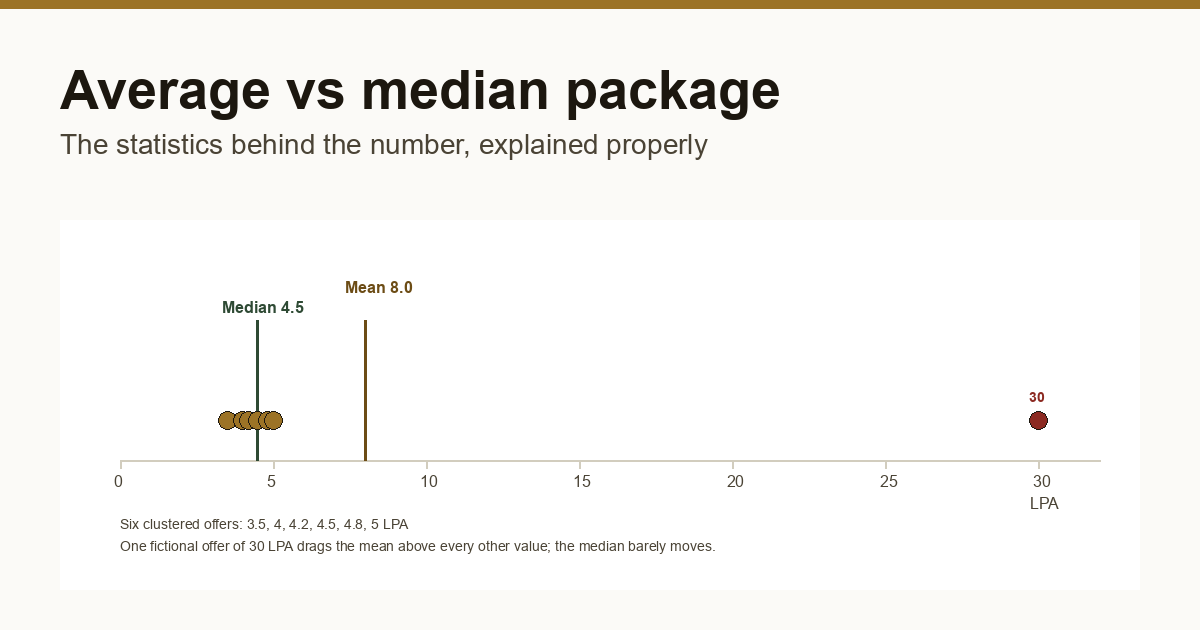
A headline "highest package" figure can come from one recruiter hiring one student out of a batch of several hundred — it says nothing about what a typical graduate earned. The median (the middle value when every package is lined up in order) or the average across the whole placed batch is a far better guide, because it is not dominated by one outlier offer. A simple illustration: five offers of 8, 8, 9, 5 and 40 (in lakhs per annum) average out to 14 — pulled upward entirely by the one offer of 40 — while the median of the same five offers is 8, which better reflects what most of that group actually received. When a report shows a big gap between its average and its median, that gap itself is informative: it usually means a small number of students received unusually large offers while most did not.
The 8 questions to ask before you believe a package
Keep this list open next to any placement claim you are evaluating.
| # | Question | Why it matters |
|---|---|---|
| 1 | Is there an actual report or disclosure document, not just a number on a banner or admissions page? | A claim with no document behind it cannot be checked |
| 2 | What academic year does it cover? | A figure from three years ago is not current |
| 3 | How many students were placed, out of how many eligible? | The denominator tells you whether "100%" means 5 students or 500 |
| 4 | Is the package figure a median or average, or only the highest offer? | A single outlier offer should never stand in for a typical outcome |
| 5 | Does the report state its own methodology (who compiled it, how placements were counted)? | Without a stated method, two reports cannot be compared fairly |
| 6 | Is the report published on the college's own official site, or only quoted secondhand by an aggregator or forum? | A secondhand mention cannot be traced back to verify |
| 7 | Does the figure match what the same college discloses elsewhere (e.g. in its AICTE mandatory disclosure, if a technical institution)? | Inconsistent figures across a college's own pages are a warning sign |
| 8 | Is the claim about placement, or about something else (internship, campus visit, training offer) being presented as a placement? | Some figures quietly blend categories that are not the same thing |
What Shalyam records for a college's placements
Shalyam's Placements field is built to hold exactly the facts a real report should contain, nothing more: the academic year the figures apply to, a link to the official report you can open yourself, the median package where the college has disclosed one, and the number of students placed. There is no field for "highest package" by design — a single outlier figure is not a fact worth building a page around. When a college's Placements field on Shalyam is labelled "Verified with source," it means a reviewer has already opened the linked report and checked that it states these things, so you do not have to start from zero.
Red flags and green flags, at a glance
- Green flag: a dated report, published on the college's own site, stating the batch size, number placed, and a median or average package.
- Green flag: a figure that matches across the college's own placement page and its AICTE mandatory disclosure (where it is a technical institution required to publish one).
- Red flag: a percentage or package with no linked document, no date, and no stated denominator.
- Red flag: only a "highest package" figure is advertised, with no median, average, or number-placed alongside it.
A fuller breakdown of red and green flags across fees, admission and placements together is covered in a later post on this series; for placements specifically, the eight questions above are the core of it.
Browse colleges on Shalyam to see this in practice.

Comments
Log in to like or comment on this post.